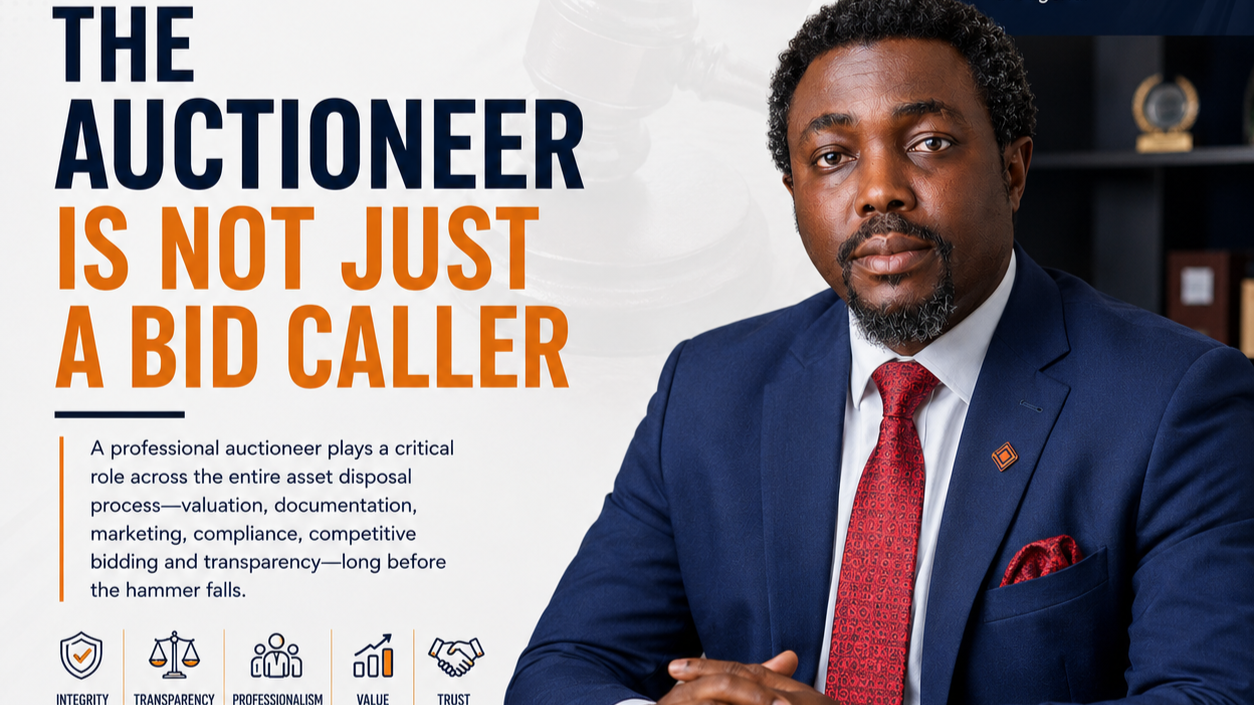
The Auctioneer Is Not Just a Bid Caller
Beyond the Hammer
I have spent enough time around auctioneering to know that the hammer is actually the least interesting part of the process.
The moment the hammer falls is only the visible conclusion of a much bigger system of work that most people never see.
Before that moment, there is valuation. There is documentation. There is verification. There is due diligence. There is marketing. There is inspection. There is compliance. There is stakeholder engagement. There is technology. There is competitive bidding. There is accountability, and, ultimately, there is trust.
That is why I believe the conversation about auctioneering in Nigeria must move beyond the auction itself.
Over the past few weeks, I have been engaging with stakeholders across the public and private sectors, including conversations around institutions, asset disposal, regulation and the future of our profession. These engagements have reinforced something I have believed for a long time: Nigeria does not simply need more auctions. Nigeria needs a stronger, more professional and more accountable auctioneering ecosystem.
The distinction matters.
Auctioneering is a professional service
An auctioneer should not be viewed merely as the person who stands behind a podium and calls out numbers.
A professional auctioneer is part of an asset-disposal process.
When a government agency, financial institution, corporation or private organisation needs to dispose of an asset, there are important questions that must be answered long before the first bid is made.
What is the asset actually worth?
How is that value established?
How is the asset presented to the market?
Who has access to the information?
How are prospective buyers allowed to inspect it?
How is the bidding process structured?
How is competition encouraged?
How is the winning bid determined?
How are records maintained?
How is payment verified?
How is ownership transferred?
And perhaps the most important question: can every stage of the process withstand scrutiny?
These are not merely auction questions. They are questions of governance, commercial practice, transparency and public trust.
This is why professional auctioneering deserves to be treated with the seriousness accorded to other regulated professional services.
The public deserves confidence in asset disposal
The disposal of public and institutional assets carries an additional responsibility.
When an asset belongs to the public, the objective cannot simply be to dispose of it quickly. The process should seek to achieve value, transparency, accountability and fairness.
The public should be able to look at an auction process and understand how the asset was valued, how it was advertised, who was eligible to participate, how bids were received and how the final outcome was reached.
That is where professional auctioneers have an important role to play.
Independence matters.
Separation of responsibilities matters.
Documentation matters.
Competitive market exposure matters.
And professional oversight matters.
Recent public debate around the proposed direct disposal of forfeited assets has brought some of these questions into sharper focus. The Nigeria Association of Auctioneers has raised concerns about the role of independent licensed auctioneers in such processes, particularly around transparency, due process and the separation of investigative or custodial functions from commercial disposal.
But for me, the larger conversation is bigger than any single agency or any single auction.
It is about the system.
We cannot build the future by defending the past
There is another conversation we need to have as an industry.
Technology is changing the way assets are marketed and sold.
Digital platforms are changing how buyers participate.
Data is changing how assets can be valued and presented.
Geography is becoming less restrictive.
A buyer should increasingly be able to participate in a properly structured auction without necessarily being physically present in the same room as the auctioneer.
Nigeria has already seen the emergence of electronic auctioning, and government institutions are increasingly engaging with digital procurement and disposal systems. The broader public-sector reform conversation is itself moving toward stronger transparency, technology and accountability.
The answer cannot be for professional auctioneers to resist technology because it changes the traditional model.
Our responsibility is to make sure technology improves the process rather than simply digitising the problems.
An online auction can still be poorly structured.
A digital platform can still lack transparency.
A sophisticated website does not automatically create a professional process.
Technology is a tool.
Professional standards are the foundation.
We need stronger institutions
If auctioneering is going to occupy the place it deserves in Nigeria’s economy, then the industry itself must become more organised.
We need stronger professional standards.
We need clearer regulatory frameworks.
We need better documentation and record keeping.
We need continuous professional development.
We need stronger relationships with government institutions, financial institutions and the private sector.
We need to embrace technology without abandoning professional ethics.
And we need institutions capable of speaking with clarity and credibility on issues affecting the profession.
This is why the conversation around the future of auctioneering cannot be reduced to who won an auction, who lost an auction, or who has the loudest voice on social media.
The real question is:
What kind of auctioneering profession do we want Nigeria to have ten years from now?
That is the question that deserves our attention.
There has already been legislative interest in strengthening the regulation of auctioneering, including proposals before the National Assembly concerning the establishment of an Auctioneers Registration Council of Nigeria.
Whatever direction the legislative and institutional conversation ultimately takes, the industry must be prepared to contribute constructively.
We cannot simply wait for somebody else to define our future.
We must participate in defining it.
The future must be built on trust
At the centre of all of this is one word: trust.
A seller must trust the process.
A buyer must trust the process.
Government must trust the process.
Financial institutions must trust the process.
The public must trust the process.
And the auctioneer must be able to stand behind the process.
That trust is not created by a logo.
It is not created by a title.
It is not created by the size of an auction catalogue.
It is earned through competence, transparency, consistency and accountability.
That is the standard I believe we should be pursuing.
And it is why the work ahead cannot be about one person, one company, one association or one administration.
It has to be about the profession.
Beyond the hammer
The hammer will always matter.
The auction will always matter.
But the future of auctioneering will be determined by everything that happens before, around and after the hammer falls.
It will be determined by the quality of our professionals.
The strength of our institutions.
The clarity of our regulations.
The technology we adopt.
The transparency of our processes.
And the confidence we create in the minds of the people we serve.
That is the conversation I believe we need to have.
Not just about how we conduct auctions.
But about how we build an auctioneering profession worthy of the trust of a modern Nigeria.
The work has begun.
And this conversation is only just beginning.
— Engr. Benjamin Isibor Abhulimen National President, Nigeria Association of Auctioneers