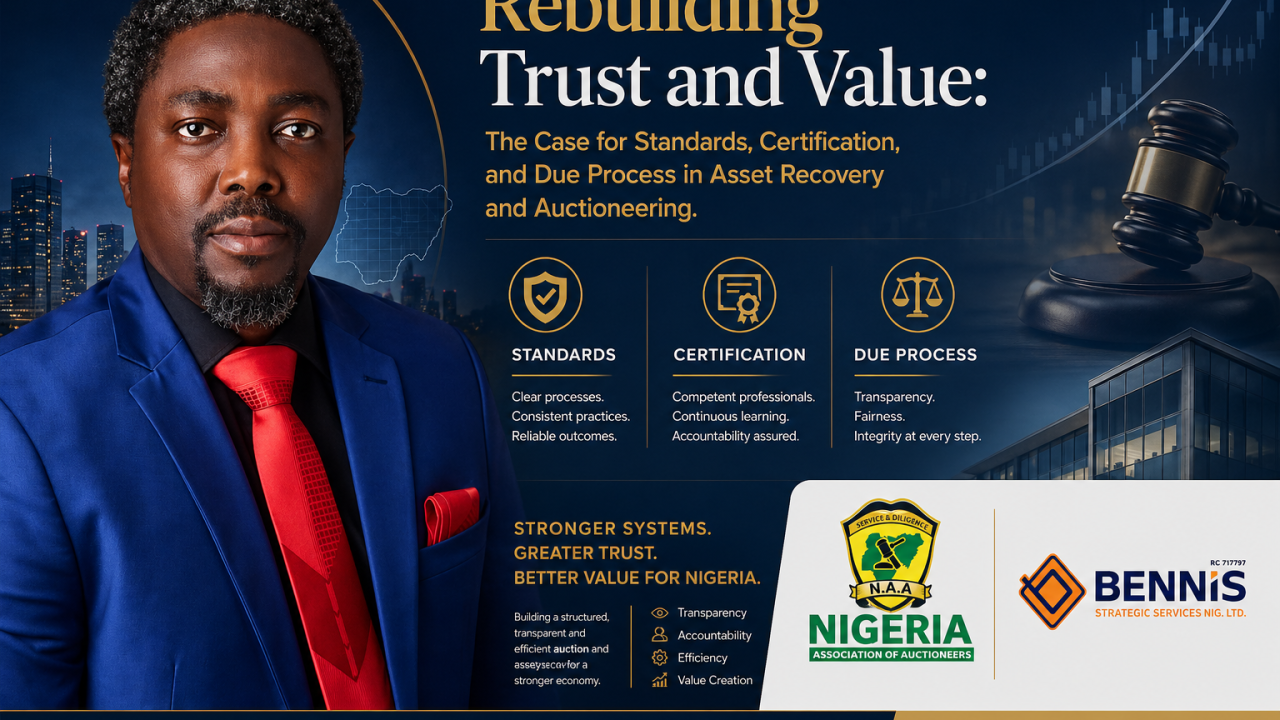
Rebuilding Trust and Value
In any system where value changes hands, trust is rarely visible, yet it determines everything.
It shapes participation. It influences outcomes. It defines whether a system merely functions—or performs.
This is particularly true in asset recovery and auctioneering, where the process itself is as important as the result it produces.
Across Nigeria, the auction and asset recovery ecosystem has never been inactive. Assets are recovered. Auctions are conducted. Transactions are completed. Institutions—public and private—continue to engage the system in one form or another.
Yet, beneath this activity lies a quieter, more important question:
Is the system working as well as it should?
For many stakeholders, the answer is not straightforward.
The challenge is not a lack of effort. It is not even a lack of opportunity. Nigeria has a significant volume of recoverable and disposable assets—ranging from financial recoveries to seized goods, distressed assets, and surplus holdings across institutions.
The issue is something more structural.
Activity has existed. Structure has not kept pace.
And where structure is weak, outcomes tend to reflect it.
Over time, I have found that the difference between a system that merely operates and one that consistently delivers value often comes down to three elements:
Standards. Certification. Due process.
These are not theoretical constructs. They are the practical foundations upon which trust is built and sustained.
In environments where standards are clearly defined, every stage of the process—from asset identification to valuation, documentation, and final disposal—follows a known and accepted path. Stakeholders understand what to expect, and consistency becomes possible.
In the absence of such standards, variation becomes the norm. Processes differ from one institution to another. Documentation is inconsistent. Outcomes become difficult to predict. Over time, this inconsistency erodes confidence.
Certification addresses a different, but equally critical dimension.
It speaks to the people within the system.
Asset recovery and auctioneering are not administrative routines. They involve judgment, technical knowledge, market understanding, and ethical responsibility. When practitioners operate without clearly defined professional thresholds, the system becomes dependent on individual discretion rather than institutional competence.
Globally, this is an area where mature markets have invested deliberately.
In the United States, for example, professional auctioneers are often required to meet licensing and continuing education standards, supported by organizations such as the National Auctioneers Association (NAA USA). In the United Kingdom, established auction houses operate within well-defined professional and regulatory frameworks, where reputation is tied not only to outcomes, but to process integrity.
These systems are not perfect. No system is. But they share a common feature: professional participation is structured, not assumed.
Certification, in this context, is not about exclusivity. It is about credibility.
It provides assurance that those entrusted with managing and disposing assets have the competence and discipline required to do so effectively.
Due process, then, is what ties everything together.
It is the mechanism through which standards and professional competence are expressed in practice.
Due process ensures that each step in the auction and recovery cycle is transparent, verifiable, and fair. It reduces ambiguity. It limits discretion. It provides a framework within which all participants—buyers, sellers, regulators, and observers—can operate with confidence.
Where due process is weak, even well-intentioned systems begin to falter.
Participation narrows because confidence declines. Value is suppressed because competition is limited. Outcomes are questioned because processes are unclear.
This pattern is not unique to Nigeria. It has been observed across multiple jurisdictions, particularly in environments where institutional systems are still evolving.
The World Bank, in its work on public asset management and governance, has consistently emphasized the role of transparent disposal systems in strengthening public financial management. Similarly, the OECD’s studies on asset recovery and anti-corruption frameworks highlight due process as a central factor in building trust and improving outcomes in public asset disposal.
These are not abstract policy recommendations. They reflect practical lessons from systems that have undergone similar transitions.
The relevance to Nigeria is immediate.
There is increasing engagement across government institutions, development partners, and private sector stakeholders around how asset recovery and auction systems can be strengthened. Conversations are no longer limited to “how do we dispose assets,” but are expanding to “how do we design systems that consistently deliver value.”
This shift in thinking is important.
It signals a movement away from isolated transactions toward system-level thinking.
From my own experience—both within Nigeria and through exposure to international practices—it has become clear that efficiency in asset recovery is rarely accidental.
It is designed.
It is built through alignment.
Alignment across institutions that hold or manage assets. Alignment across practitioners responsible for executing processes. Alignment in expectations, standards, and accountability mechanisms.
Without this alignment, even the most active systems remain fragmented.
With it, the same system can produce entirely different outcomes.
This becomes particularly significant when viewed through the lens of internally generated revenue (IGR).
As governments seek sustainable revenue sources, the role of structured asset recovery becomes more prominent. Assets that would otherwise remain dormant or underutilized can be converted into measurable value—but only if the system managing them is efficient, transparent, and trusted.
The opportunity here is substantial.
But opportunity alone is not enough.
It must be matched with deliberate action.
This includes strengthening institutional frameworks that govern asset recovery processes. It requires the development and enforcement of professional standards across the industry. It calls for investment in capacity—ensuring that practitioners are equipped with the knowledge and tools required to operate within a more structured environment.
Digital transformation also has a role to play.
In many mature markets, the introduction of e-auction platforms has expanded participation, improved price discovery, and enhanced transparency. Platforms such as GSA Auctions in the United States demonstrate how centralized, technology-enabled systems can improve both efficiency and accountability in public asset disposal.
Nigeria stands at a point where similar advancements can be pursued.
However, technology alone will not solve structural issues.
Without standards, certification, and due process, digital systems risk replicating existing inefficiencies at scale.
The foundation must come first.
There is also a leadership dimension to this transition.
Systems do not evolve on their own. They are shaped by the decisions, priorities, and commitments of those within them.
For the auctioneering profession, this means a conscious move toward greater discipline, greater accountability, and a shared understanding of what professionalism entails.
Professionalism, in this context, cannot be left to interpretation.
It must be defined. It must be taught. It must be enforced.
Because the credibility of the entire system rests on it.
At a broader level, the role of auctioneering within Nigeria’s economic architecture is evolving.
It is no longer sufficient to view it as the final step in a process.
It must be understood as a critical component of how value is recovered, redistributed, and reintegrated into the economy.
This requires a different approach.
One that prioritizes systems over transactions. Structure over activity. Consistency over improvisation.
The work ahead is not about doing more.
It is about doing better.
Building a system where:
Standards are clear and consistently applied. Practitioners are certified and accountable. Processes are transparent and respected. Outcomes are reliable and trusted.
A system where trust is not assumed—but earned, repeatedly, through the integrity of its processes.
This is not an overnight transition.
It will require sustained effort, collaboration, and a willingness to move beyond established patterns.
But it is necessary.
Because in the end, the strength of any system is not measured by how often it operates, but by how well it performs and in asset recovery and auctioneering, performance is ultimately defined by trust.
#Auctions #AssetRecovery #Nigeria #Governance #PublicSector #Transparency